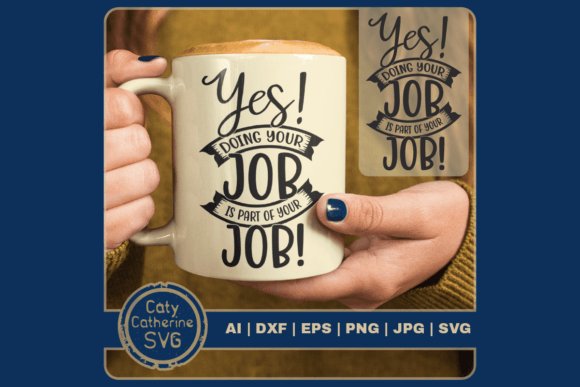
Reviewing Yes Doing Your Job is Part of Your Job
As a designer who spends more time staring at stitch simulations than I do sleeping, I have learned that the best embroidery designs are not always the most intricate. Sometimes, the most impactful pieces are those that rely on clean typography and a sharp, relatable message. Recently, I evaluated Yes Doing Your Job is Part of Your Job, a witty office quote graphic designed by Caty Catherine. While this asset is marketed primarily as an SVG cut file for Crafts and Graphics applications, my interest lay in how this typographic design translates into a tangible, stitched reality for commercial and personal use.
First Impressions and Visual Personality
The immediate appeal of Yes Doing Your Job is Part of Your Job lies in its blunt, humorous honesty. In the world of corporate satire and office culture merchandise, clarity is king. The design does not clutter the visual field with unnecessary flourishes or complex illustrations. Instead, it leans into a bold, straightforward layout that demands attention. For an embroidery project, this simplicity is a double-edged sword that requires careful handling. Without decorative elements to hide behind, the quality of the lettering and the spacing between characters become the focal points.
The mood created by this piece is playful yet professional enough for a "work-safe" environment. It fits naturally into the genre of modern, minimalist humor that appeals to millennials and Gen Z workers alike. When I first loaded the vector file to inspect the paths, I looked for smooth curves and consistent stroke widths. These are critical indicators of how well a design will digitize. A messy vector often leads to a messy stitch file, resulting in thread breaks and poor coverage.
Real-World Application: The Office Tote Scenario
To truly test the viability of this design, I imagined a specific real-life scenario: creating a custom embroidered tote bag for a local boutique’s employee appreciation week. Tote bags are staple items for Etsy sellers and small shop owners because they offer a large, flat canvas for text-based designs. Using Yes Doing Your Job is Part of Your Job on a heavy cotton canvas tote allows the text to breathe. The sturdy fabric supports the weight of the stitching without puckering, provided the correct stabilizer is used.
In this context, the design serves as both a conversation starter and a badge of honor for the recipient. It transforms a mundane accessory into a personalized gift with personality. However, the success of this product hinges on execution. If the letters are too small, the humor is lost in a blur of thread. If they are too large, the bag becomes stiff and unwieldy. Finding that sweet spot is where the designer’s eye matters most.
Performance on Different Fabrics and Hoops
One of the biggest challenges with text-heavy designs like this is adapting them to various substrates. While it shines on a tote bag, applying it to a sweatshirt embroidery project requires a different approach. Fleece and cotton blends have a nap that can swallow fine details. For a hoodie or crewneck, I would recommend increasing the font size slightly and ensuring high contrast between the thread colors and the fabric. A white thread on a heather gray sweatshirt might lack definition, whereas a navy or black thread would pop effectively.
Curved surfaces present another hurdle. Embroidering this quote on a cap or hat demands precise centering. The phrase is relatively long, so fitting it within a standard 5x7 or 4x4 hoop might require breaking the text into two lines or using a smaller, condensed font variation if available. If the design is stretched over the curved front panel of a cap, the outer letters may distort. This is why testing on scrap fabric is non-negotiable. You must verify that the stitch density does not cause the fabric to pucker, which is a common issue with dense fill stitches on stretchy materials.
Considerations for Small Details and Texture
When working with thin fabric or lightweight tees, the backing becomes just as important as the design itself. A cut-away stabilizer is usually preferred for garments that will undergo frequent washing, ensuring the design remains stable over time. Conversely, for a decorative pillow cover or a wall hanging that sees less wear, a tear-away stabilizer might suffice. The key is to match the stability of the support to the tension of the stitches.
Additionally, consider the fabric texture. On textured towels or waffle-weave aprons, the needle may skip or the thread may sink into the weave. In these cases, using a water-soluble topping can help the stitches sit on top of the fabric rather than disappearing into it. This is particularly relevant for kitchen-themed gifts or holiday embroidery projects where tea towels are popular items.
Commercial Value and Brand Consistency
For craft business owners and digital product sellers, the versatility of this design is a major selling point. It appeals to a broad demographic, from administrative assistants to tech workers. When listing this as a finished product on platforms like Etsy, the perceived value increases when the stitching is crisp and the presentation is professional. Buyers are not just purchasing a quote; they are buying the quality of your craftsmanship.
Using Yes Doing Your Job is Part of Your Job in your portfolio demonstrates an understanding of current trends. It shows that you can handle typographic designs with precision. This builds customer trust and encourages repeat business. Moreover, because the design is simple, it is cost-effective to produce. Lower stitch counts generally mean faster machine run times, allowing for better profit margins on items like embroidered patches or bulk orders for corporate clients.
Practical Designer Notes for Execution
Before you commit to stitching this design on a final product, keep these practical tips in mind:
- Check the License: Since this is a digital asset designed by Caty Catherine, always confirm the licensing terms. Ensure you have the right to use it for commercial purposes if you plan to sell the finished items.
- Digitization Quality: If you are converting the SVG to a machine embroidery file yourself, pay close attention to the underlay stitches. Proper underlay prevents shifting and ensures the top stitches lay flat.
- Contrast Testing: Create mockups in both black and white to see how the design holds up without color. If it looks good in monochrome, it will look great in color.
- Hoop Size Selection: Choose the smallest hoop that comfortably fits the design to minimize stabilization issues and maximize hoop efficiency.
- Thread Choice: Polyester threads offer durability and sheen, making them ideal for items that will be washed often, such as baby embroidery items or daily-use apparel.
In conclusion, Yes Doing Your Job is Part of Your Job is a strong contender for any designer’s library. Its strength lies in its simplicity and relatability. By paying attention to fabric choice, stabilizer selection, and stitch density, you can transform this simple graphic into a high-quality, professional-grade embroidery piece. Whether for a custom apparel line or a one-off gift, this design offers a blend of humor and style that resonates with modern audiences.